Da das externe Sensormodul hinsichtlich der Stromaufnahme (noch) nicht optimiert ist, starte ich den Solartest ohne diesem Modul.
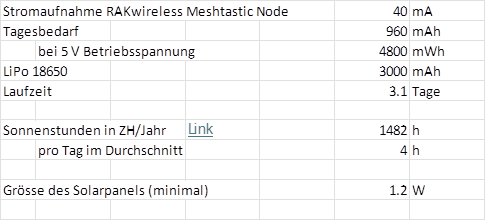
Eine Überschlagsrechnung zeigt, dass mit einem 5 V/3 W-Solarpanel und einem Li-Ion-Akku 18650 der Strombedarf gedeckt sein könnte. Die theoretische Laufzeit von ca. 3 Tagen ist für die Überbrückung einer Dunkelflaute allerdings knapp bemessen.
Die Seeed Studio XIAO-Serie ist eine Familie kompakter, leistungsstarker Mikrocontroller-Module (MCU), die speziell für platzsparende Projekte entwickelt wurden, die hohe Leistung und drahtlose Konnektivität erfordern.
Die Arduino-kompatible XIAO-Familie stellt Mikrocontroller-Module auf Basis verbreiteter Hardware wie Espressif ESP32-C3, ESP32-C6 & ESP32-S3, Renesas RA4M1, Raspberry Pi RP2350 & RP2040, Nordic nRF52840, Microchip SAMD21 und Silicon Labs MG MG24 zur Verfügung.
Der ESP32-S3 ist das erste Modul, das mit einem B2B-Connector (Board-zu-Board) ausgestattet ist und über diesen mit anderen Modulen erweitert werden kann. Die folgende Abbildung zeigt eine Draufsicht auf das XIAO-ESP32-S3.
An der Unterkante des Moduls befinden sich der IPEX-Stecker für die WiFi-Antenne und daneben der 30-polige B2B-Connector.
The Seeed Studio XIAO series is a family of compact, high-performance microcontroller modules (MCU) designed explicitly for space-saving projects that require high performance, and wireless connectivity.
The Arduino-compatible XIAO family provides microcontroller modules based on popular hardware such as Espressif ESP32-C3, ESP32-C6 & ESP32-S3, Renesas RA4M1, Raspberry Pi RP2350 & RP2040, Nordic nRF52840, Microchip SAMD21, and Silicon Labs MG MG24.
The ESP32-S3 is the first module to be equipped with a B2B connector (board-to-board) and can be expanded with other modules via this connector. The following figure shows a top view of the XIAO-ESP32-S3.
The IPEX connector for the WiFi antenna is located on the bottom edge of the module, with the 30-pin B2B connector next to it.
XIAO ESP32-S3
Ein Wio-SX1262 Modul erweitert den ESP32-S3 zum Meshtastic Device und nutzt den B2B-Connector zur Verbindung der beiden Module. Die folgende Abbildung zeigt das über den B2B-Connector mit dem ESP32-S3 verbundene LoRa-Modul Wio-SX1262.
A Wio-SX1262 module expands the ESP32-S3 into a meshtastic device and uses the B2B connector to connect the two modules. The following figure shows the Wio-SX1262 LoRa module connected to the ESP32-S3 via the B2B connector.
Wio-SX1262 & ESP32-S3
Zum Experimentierumfeld braucht es aber weiterer Komponenten, die eine einfache Kontaktierung von Sensorik ermöglichen. Grove- und M5Stack-Sensoren weisen eine einheitliche (Grove-) Schnittstelle auf und sind deshalb ganz besonders geeignet.
Die aktuell von Meshtastic unterstützen Sensoren sind in der folgenden Tabelle gelistet. In den Spalten Grove und M5Stack sind die dazu passenden Grove- resp. M5Stack-Sensoren ergänzt. Die Detailinfomationen finden Sie auf den Herstellerseiten über die angegebenen Links.
However, the experimental environment requires additional components that enable the simple contacting of sensors. Grove and M5Stack sensors have a standardized (Grove) interface and are particularly suitable.
The sensors currently supported by Meshtastic are listed in the following table. The corresponding Grove and M5Stack sensors are added in the Grove and M5Stack columns. You can find detailed information on the manufacturer’s website via the links provided.
ENV II Unit with Temperature Humidity Environment Sensor (SHT30+BMP280) ENV IV Unit with Temperature Humidity Air Pressure Sensor (SHT40+BMP280)
BME280
0x76, 0x77
Temperature, barometric pressure and humidity
Grove -Temp&Humi&Barometer Sensor (BME280)
BME68x
0x76, 0x77
Temperature, barometric pressure, humidity and air resistance
Grove – Temperature, Humidity, Pressure and Gas Sensor for Arduino – BME680 Grove – Air Quality Sensor(BME688) with built-in AI, High-Performance 4-in-1, Gas, Humidity, Pressure and Temperature sensor
ENV Pro Unit with Temperature, Humidity, Pressure and Gas Sensor (BME688)
MCP9808
0x18
Temperature
Grove – I2C High Accuracy Temperature Sensor – MCP9808
INA260
0x40, 0x41, 0x43
Current and Voltage
INA219
0x40, 0x41, 0x43
Current and Voltage
INA3221
0x42
3-channel Current and Voltage
LPS22
0x5D, 0x5C
Barometric pressure
SHTC3
0x70
Temperature and humidity
SHT31
0x44
Temperature and humidity
Grove – Temperature&Humidity Sensor (SHT31)
PMSA003I
0x12
Concentration units by size and particle counts by size
Heart Rate, Oxygen Saturation, and body temperature
Mini Heart Rate Unit (MAX30100) Pulse Oximeter
MLX90614
0x5A
Body temperature
Grove – Thermal Imaging Camera – MLX90641
NCIR 2 Thermometer Unit (MLX90614) NCIR Non-Contact Infrared Thermometer Sensor Unit (MLX90614)
Die XIAO-Familie bietet für die einfache Erweiterung mit den genannten Senoren über den I2C-Bus das XIAO-Expansionboard an.
Es stehen aber auch ein UART- und ein IO-Interface (A0, D0) zur Verfügung.
The XIAO family offers the XIAO expansion board for simple expansion with the above sensors via the I2C bus .
However, a UART and an IO interface (A0, D0) are also available.
XIAO Expansion Board
Das UART-Interface kann für den Anschluss eines GPS-Moduls, wie beispielsweise der in der folgenden Abbildung gezeigten M5Stack GPS Unit, verwendet werden.
You can use the UART interface to connect a GPS module, such as the M5Stack GPS Unit shown in the following figure.
Zusätzlich weist das Board noch ein OLED-Display und einen Batterieanschluss auf. Die Batterie kann über USB geladen werden. Ein Solaranschluss steht nicht zur Verfügung.
Modbus continues to be a widely used communication protocol in industrial automation and control systems. RS-485 provides a robust and reliable physical layer for long-distance communication, and Modbus RTU is a popular protocol for exchanging data between devices from different manufacturers in various industrial applications.
Despite the emergence of newer protocols and technologies, Modbus RTU over RS-485 will continue to be widely used in the industry due to its simplicity, compatibility with existing systems, and broad support.
Various bridges connect a Modbus network to the IoT for further data processing and visualization, which is essential today. Modbus LoRaWAN bridges, offered by various users, can be used to make this connection.
Modbus ist nach wie vor ein weit verbreitetes Kommunikationsprotokoll in industriellen Automatisierungs- und Steuerungssystemen. RS-485 bietet eine robuste und zuverlässige physikalische Schicht für die Kommunikation über große Entfernungen, und Modbus RTU ist ein beliebtes Protokoll für den Austausch von Daten zwischen Geräten verschiedener Hersteller in verschiedenen industriellen Anwendungen.
Trotz des Aufkommens neuerer Protokolle und Technologien wird Modbus RTU über RS-485 aufgrund seiner Einfachheit, der Kompatibilität mit bestehenden Systemen und der breiten Unterstützung weiterhin in der Industrie weit verbreitet sein.
Verschiedene Bridges verbinden ein Modbus-Netzwerk mit dem IoT zur weiteren Datenverarbeitung und -visualisierung, was heute unerlässlich ist. Modbus LoRaWAN-Bridges, die von verschiedenen Anwendern angeboten werden, können für diese Verbindung genutzt werden.
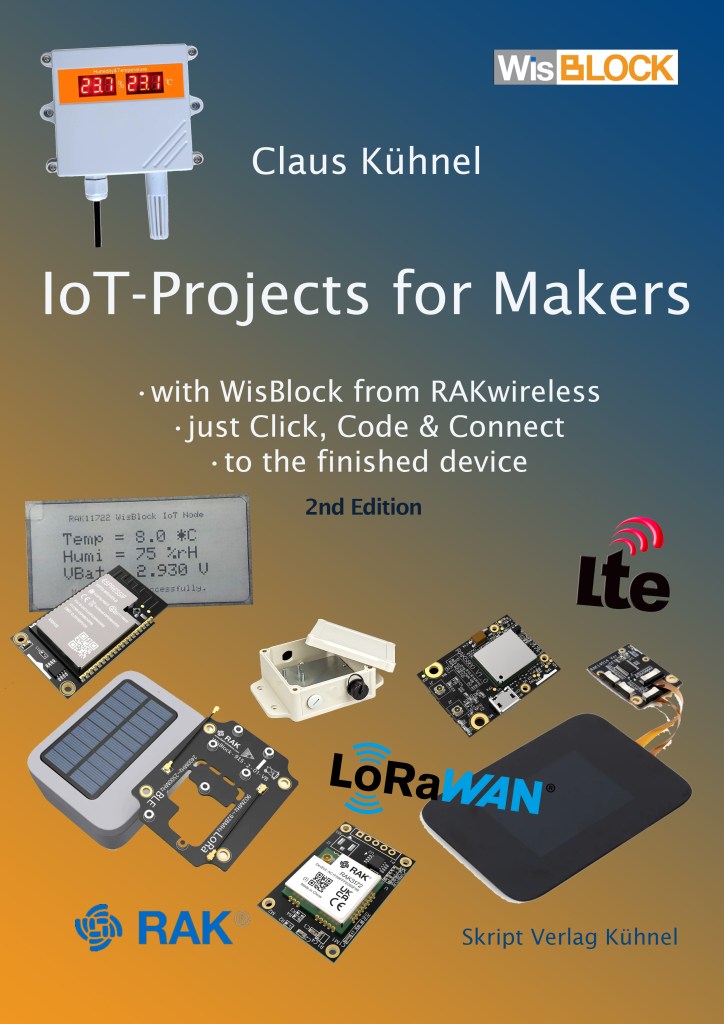
In meinem Buch IoT Projects for Makers habe ich unter anderem eine Lösung vorgestellt, um Messwerte eines Modbus-Sensors per Pushover mit Hilfe von WisBlock-Modulen auf ein Mobiltelefon zu veröffentlichen.
The same technology can be used to transfer messages to a LoRaWAN network server. The WisBlock ecosystem helps with rapid prototyping.
Mit der gleichen Technologie können Sie Nachrichten an einen LoRaWAN-Netzwerkserver übertragen. Das WisBlock-Ökosystem hilft bei der schnellen Entwicklung von Prototypen
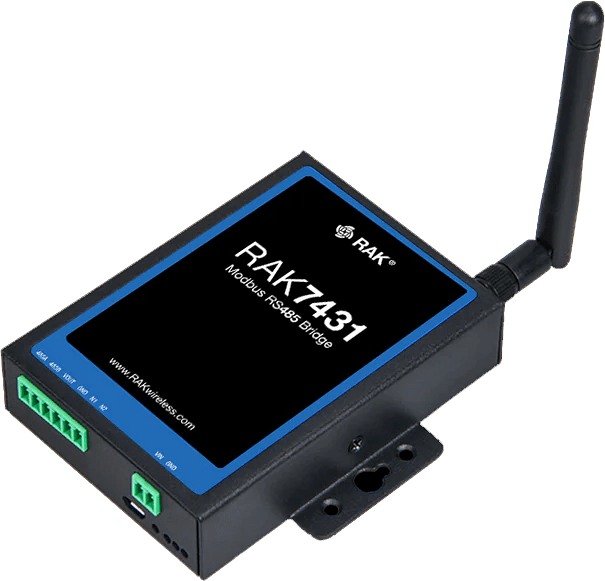
RAK7431
RAKwireless offers an industrial solution with the WisNode Bridges and in particular the RAK7431 WisNode Bridge Serial, an RS485 to LoRaWAN converter for industrial applications. The device transmits data from Modbus sensors over LoRaWAN for wireless transmission to and from end devices.
Using the LoRaWAN 1.0.3 protocol stack, the device supports LoRaWAN Class A, B and C, enabling cloud management of ModBus/RS-485 devices.
Eine industrielle Lösung bietet RAKwireless mit den WisNode Bridges und hier vor allem mit der RAK7431 WisNode Bridge Serial, einem RS485 to LoRaWAN converter für industrielle Anwendungen. Das Gerät übermittelt Daten von Modbus-Sensoren über LoRaWAN zur drahtlosen Übertragung von und zu Endgeräten.
Mit dem LoRaWAN 1.0.3 Protokollstack unterstützt das Gerät LoRaWAN Class A, B und C und ermöglicht so ein Cloud-Management von ModBus/RS-485-Geräten.
Environmental sensors monitor the temperature and humidity levels in different rooms of a building and enable the system to intelligently adjust the HVAC settings. A dynamic control ensures a comfortable and healthy indoor environment
RAKwireless offers the QingPing Temperature & Humidity Pro S a professional-grade sensor specifically tailored for environmental and greenhouse applications.
The device supports configurable reporting and notification options, keeping users informed about critical changes in temperature and humidity levels.
Umgebungssensoren überwachen Temperatur- und Luftfeuchtigkeit in den verschiedenen Räumen eines Gebäudes und ermöglichen eine intelligente Anpassung der HLK-Einstellungen. Eine dynamische Steuerung sorgt für ein angenehmes und gesundes Raumklima.
RAKwireless bietet mit dem QingPing Temperature & Humidity Pro S einen professionellen Sensor, der speziell für Umwelt- und Gewächshausanwendungen entwickelt wurde.
Das Gerät unterstützt konfigurierbare Berichts- und Benachrichtigungs-optionen, die den Benutzer über kritische Änderungen der Temperatur- und Luftfeuchtigkeitswerte informieren.
For Device Configuration and Data Description read the User Manual.
The sensor sends different messages like historical data, real-time data, events, etc.
At this time, QingPing does not offer a payload decoder; therefore, I wrote a simple one for decoding the real-time data message.
Zur Gerätekonfiguration und Datenbeschreibung lesen Sie bitte das Benutzerhandbuch.
Der Sensor sendet verschiedene Nachrichten wie historische Daten, Echtzeitdaten, Ereignisse usw.
Da QingPing derzeit keinen Payload-Decoder anbietet, habe ich einen einfachen Decoder für die Dekodierung der Echtzeitdaten geschrieben.
function decodeUplink(input) {
  var data = {};
  if (input.bytes[1] == 0x41 && input.bytes[3] == 0x01) {
    data.msg = "RTD";
    data.temp = ((((input.bytes[8] << 8) + input.bytes[9]) >> 4) - 500)/10;
    data.humi = ((((input.bytes[9] << 8) + input.bytes[10]) & 0x0FFF))/10;
    data.bat = input.bytes[13];
  }

  return {
    data: data
  };
}
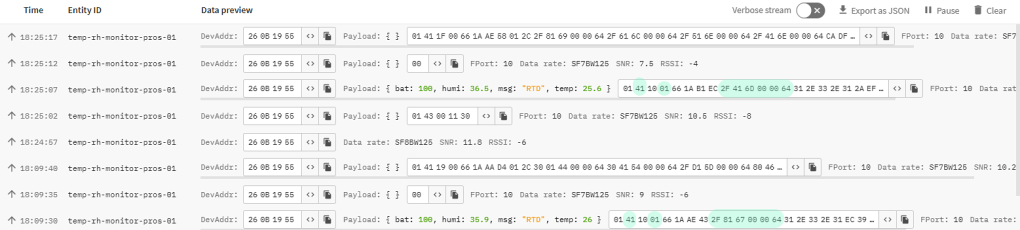
Using this payload decoder, the TTS console shows the following messages. As you can see, only the real-time data messages beginning with 01 41 xx 01 are decoded.
Bei Verwendung dieses Payload-Decoders zeigt die TTS-Konsole die folgenden Meldungen an. Wie Sie sehen können, werden nur die Echtzeitdatenmeldungen, die mit 01 41 xx 01 beginnen, dekodiert.
Thanks to RAKwireless for this LoRaWAN gift at Embedded World 2024 and the good conversations at the booth. It reminds me of my visit there.
I have been using Kachelmannwetter’s information and following their weather forecast on YouTube for a long time.
Kachelmannwetter provides extensive weather and environmental data, as well as webcam recordings. Interested parties can also contribute weather data to complete the range of data on offer.
I have taken up the invitation and, as a new Citizen Scientist, I am now also making my SensorHub data available on the Meteologix platform.
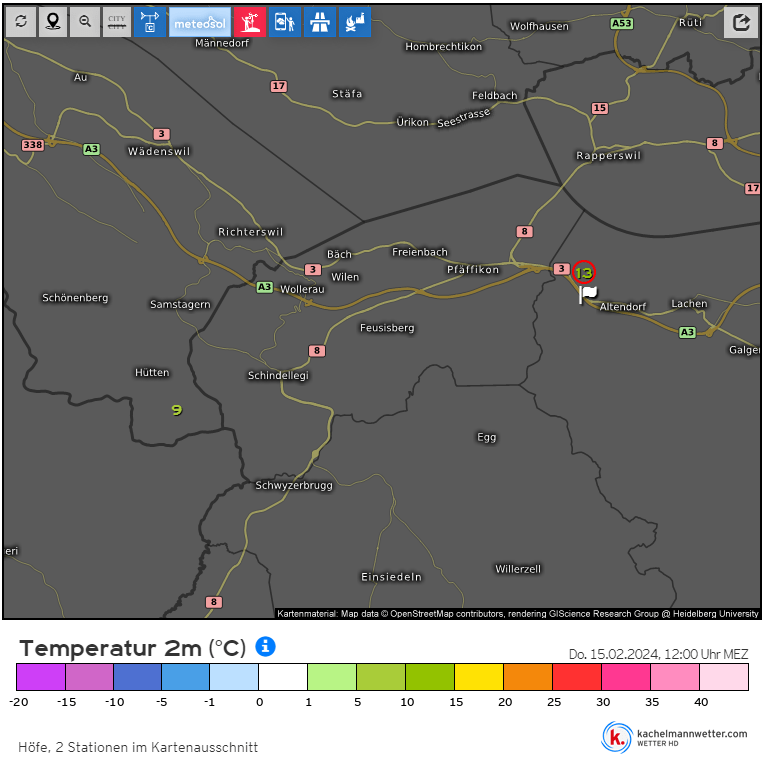
The images below display the professional and amateur weather stations in my area. Additionally, the graph depicts the ambient temperature measured at a height of 2 meters over a 72-hour period.
Schon lange nutze ich die Informationen von Kachelmannwetter und verfolge die Wettervorhersage auf Youtube.
Neben der Bereitstellung umfangreicher Wetter- und Umweltdaten sowie Webcam-Aufnahmen können Interessenten Wetterdaten beisteuern und so das Angebot an Daten komplettieren.
Ich habe die Aufforderung aufgegriffen und stelle als neuer Citizen Scientist nun meine SensorHub Daten auch auf der Meteologix Plattform bereit.
In den folgenden Bildern sind die Profi- und Amateur-Wetterstationen meiner Gegend gezeigt. Abschließend ist der 72 h Verlauf der Umgebungstemperatur gemessen in 2 m Höhe gezeigt.
Profi Weather StationsAmateur Weather StationsSensorHub 72 h Weather Data
RAKwireless‘ SensorHub is a modular ecosystem consisting of the main body and multiple pre-configured sensor probes. With pluggable, interchangeable probes and the option to add third-party sensors to the system, the Sensor Hub is a suitable and versatile solution platform for various IoT applications where environmental monitoring is needed outdoors.
The SensorHub can work battery-powered by non-rechargeable or solar-powered batteries or with an external power supply, depending on the application and deployment location.
For data transmission into Low-Power Wide-Area Network (LPWAN), LoRaWAN is available. Alternatively, NB-IoT can be used.
As a typical low-code system, it requires configuration with the WisToolBox app from a cell phone. WisToolBox also enables access to the measured values of all connected sensors, as the following screenshots show.
Screenshots of WisToolBox app
The eBook SensorHub IoT Applications will be available from Amazon from November 15, 2023. Pre-orders are already possible.
This eBook introduces the SensorHub system and its usage in industrial-grade IoT applications using LoRaWAN for communication.
The first image shows a SensorHub with a connected SensorProbe equipped with WisBlock sensors. This application is suitable for powering by batteries, too.
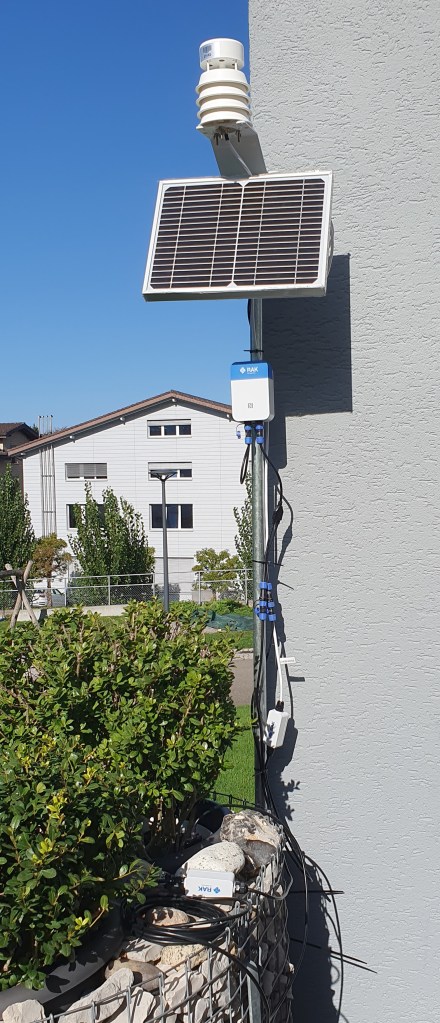
The second image shows a SensorHub Measuring Station built by RK900-09 Weather Station, RK520-02 Soil Moisture Sensor, and RAK9154 Solar Battery. These components build an autonomous working measuring station. The measuring station was installed to test the acquisition of the measuring values via the connected sensors on the one hand and its behavior regarding solar-buffered battery operation in the darker season on the other hand.
The RK900-09 Weather Station described in my post RK900-09 Weather Station on SensorHub is the base for this SensorHub Measuring Station built by RK900-09 Weather Station, RK520-02 Soil Moisture Sensor, and RAK9154 Solar Battery. These components manufactured by RAKwireless build an autonomous working measuring station.
The measuring station was installed to test the acquisition of the measuring values via the connected sensors on the one hand and its behavior regarding battery operation in the darker season on the other hand.
The SensorHub periodically sends the measuring values to the TTN (CE) LNS. Datacake serves as a visualization platform, as the following screenshots show.
Datacake Dashboard
You can follow the acquired data on the Datacake dashboard via this Public Link.
Details of the implementation and required adaptions to the payload decoder for both platforms, as well as further hints to SensorHub, will be published in the eBook mentioned in the post RAKwireless IoT Applications.
IoT applications usually require interdisciplinary collaboration between different disciplines during development and implementation.
With WisBlock, RAKwireless created a system accompanying the entire development path to the finished device using industrial-grade yet cost-effective components. Additionally, it offers the possibility to integrate components of prototyping systems from third-party providers into WisBlock.
With these systems, you can solve various tasks. Still, many steps are necessary to get a finished device, e.g., autonomy usable as a sensor node in harsh environments, which can be tedious.
True to the philosophy „IoT Made Easy,“ RAKwireless has ensured with WisBlock that this new solution is as simple as Click – Code – Connect!
I described the WisBlock ecosystem in an eBook titled „IoT-Projects for Makers: with WisBlock from RAKwireless • just Click, Code & Connect • to the finished device.“
Continuing this design philosophy, based on WisBlock, RAKwireless developed the RAK2560 WisNode SensorHub.
RAKwireless SensorHub is a modular ecosystem consisting of the main body and multiple pre-configured sensor probes. With pluggable, interchangeable probes and the option to add third-party sensors to the system, the Sensor Hub is a suitable and versatile solution platform for various IoT applications where environmental monitoring is needed outdoors.
The SensorHub can work battery-powered by non-rechargeable or solar-powered batteries or with an external power supply, depending on the application and deployment location.
For data transmission into Low-Power Wide-Area Network (LPWAN), LoRaWAN is available. Alternatively, NB-IoT can be used.
As a typical low-code system, it essentially requires configuration with the WisToolBox app from a cell phone.
I am currently working on applications of SensorHub in IoT using the example of measuring environmental data.
An eBook titled „SensorHub IoT Applications: • with WisNode SensorHub from RAKwireless • just configure & connect • to the finished application.“ is in preparation.
The planned release date is 11/15/2023, and pre-orders are available on Amazon.
The Sensor Hub equipped with a Sensor Probe containing Temperature and Humidity Sensor RAK1901 and Pressure Sensor RAK1902 was used to measure environmental data (Link).
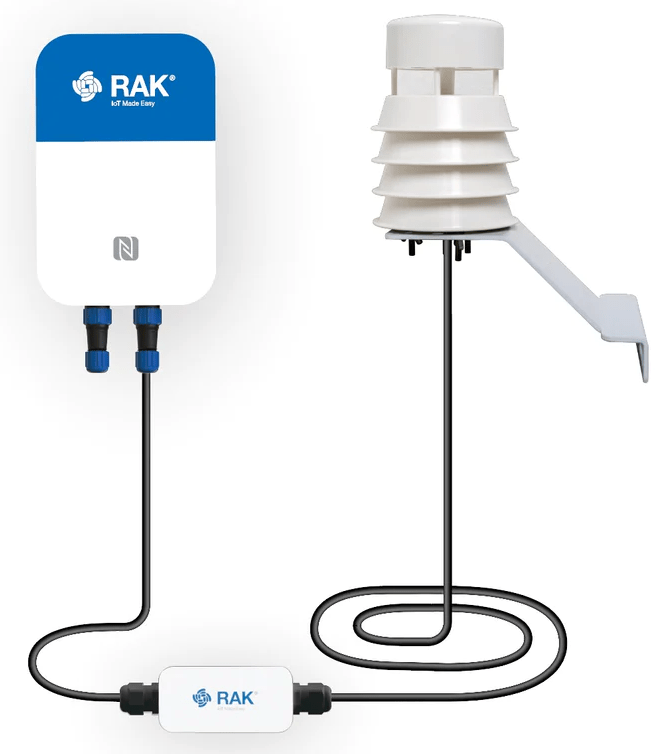
RAKwireless offers the RK900-09 Weather Station more precise equipment for measuring weather conditions.
MEMS sensors measure temperature, humidity, barometric pressure, and ultrasonic sensors wind speed and direction. You will find the technical data on the manufacturer’s website.
The SensorProbeIO associated with the RK900-09 connects the RS-485 output of the RK900-09 to the SensorHub interface.
The payload decoder provided by RAKwireless needed minor adaptations and is available on GitHub.
For visualization, I use Datacake again and get the following data output of this Weather Station.
Datacake Dashboard
Use this QR code or public link to get the actual weather data measured by RK900-09 Weather Station connected to SensorHub.












 ck blog